

2025
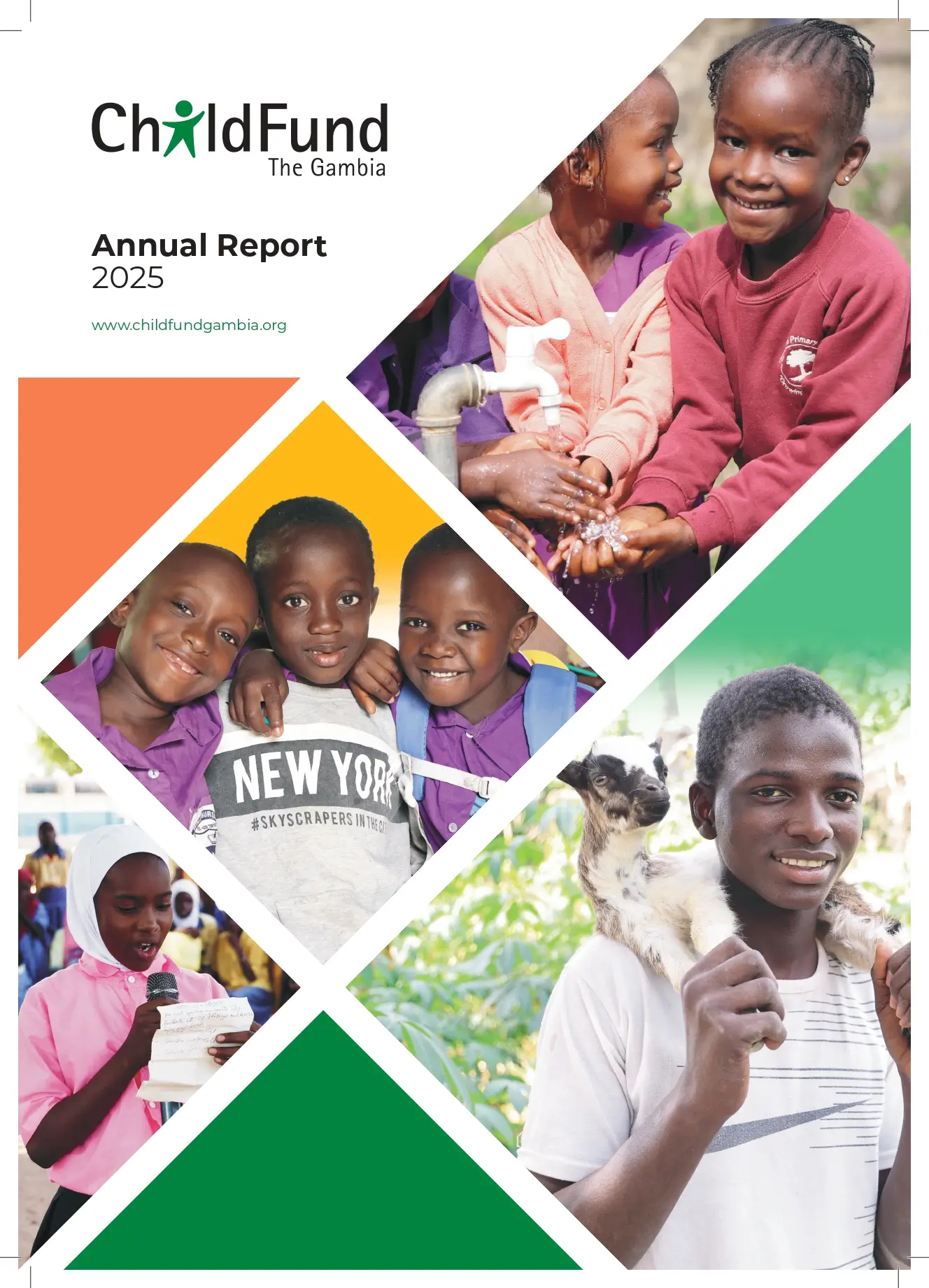
ChildFund The Gambia’s 2025 Annual Report highlights the progress made in improving the lives of vulnerable children and their communities across the country. This report reflects the collective efforts of our staff, local partners, and supporters in delivering impactful, child-centred programmes nationwide. The report showcases key achievements, powerful stories of change, and our continued commitment to ensuring that every child in The Gambia grows up healthy, educated, skilled and safe to reach their full potential.
2024
ChildFund The Gambia in collaboration with UNPFA and the Gambia Federation of the Disabled (GFD) commissioned this mapping exercise the document the existence of women groups living with disability within Organisations of Persons with Disabilities (OPDs)

2023
UNICEF, in partnership with the Education Above All Foundation, ChildFund, the Ministry of Basic and Secondary Education, and EFANET Gambia, is implementing the Zero Out of School Children (ZOOSC) Project to support inclusive and equitable access to education across The Gambia. Through sustained investment and advocacy, UNICEF continues to drive systemic change to ensure that all children, including the most vulnerable, can access quality learning opportunities. As a result of the ZOOSC Project, 29,556 children aged 7 to 12 years were enrolled at the start of the 2023 academic year, marking a significant step toward achieving education for all.
2025
ChildFund recognizes that environmental changes are not only ecological challenges but also a serious child rights crisis, directly threatening children’s survival, development, and future. In response, we implement child-centered, locally-led programs aligned with The Gambia’s Nationally Determined Contributions (NDCs), National Adaptation Plan (NAP) and the National Climate Change Policy and Disaster Risk Reduction and Resilience Framework. Our strategy integrates environmental action across all programmatic areas — including health, education, child protection, water resource management, food security and livelihoods — while promoting adaptation and environmental stewardship at all levels of society. Through innovative, community-driven approaches, we equip children and youth to lead efforts that build resilience, foster adaptation, and support mitigation for a sustainable future.
2023
This report documents the findings of a mixed-methods end-line evaluation of the responsive and protective parenting program implemented in the Fonis and Kombo East and Central districts of The Gambia. The evaluation used Focus Group Discussions (FGDs) and Key Informant Interviews (KIIs) to collect additional evidence to support and/or explain the quantitative survey findings. It also conducted a comprehensive review of project initiation documents and reports from both ChildFund The Gambia and the two Federation partners. Overall, endline evaluation findings reveal an improvement in the caregivers’ knowledge, attitudes, and practices on responsive parenting practices. Positive changes observed by mentors and facilitators as was reported during KIIs include increase in early stimulation; caregivers' knowledge of child development and support for learning; better awareness of child protection and more consistent use of positive parenting practices.
2022
This report documents the findings of the evaluation of this project, also referred to as the Playful Parenting Project (PPP). The project according to the report had a very large and significant effect in improving respondent knowledge on child development. At baseline, only about 44 % of the respondents reported any knowledge, a proportion that more than doubled at the endline so that nearly all respondents reported knowing about child development at the endline (96 %). From the data, most of the changes in this knowledge appears to be driven by health workers and community health volunteers (CHVs), who were reported by 62 % and 38% of respondents as a source of the information. Outside of health workers and CHVs, grandparents were also an important source of knowledge shift, with 16 % of respondents citing them as a source. Owing to the design of the project, health workers and CHVs certainly play an important role in changing knowledge on child development at the endline. Incorporating grandparents, however, might also offer an alternative and indeed sustainable channel, given that outside of the other two, they were reported as the most important source. At the baseline, they were indeed the most reported source of information on child development. This result is promising for two reasons. First, it signifies potential trickle-down effects of the playful parenting intervention to future generations. If indeed, as the findings suggest, caregivers look to their parents for information on child development, then any knowledge that is acquired caregivers from the intervention is very likely to trickle-down beyond the current cohort of children to their grandchildren, great grandchildren and possibly beyond.
2020
Being one of the first parenting interventions in The Gambia to address early childhood development, the Parenting project targeted 1,200 parents and caregivers of children age 0-6 years in 30 rural villages in three regions (Lower River Region, Central River Region and North Bank Region). Regions were selected where enrolment in pre-primary education was below the national average. In the relatively short time that the project delivered its activities, there is evidence of acceptability to communities, demand for replication, and valued benefits including improved relationships, father involvement in caregiving, and adoption of practices promoting child well-being.
The Power of Child Sponsorship: From Dreams to Reality – Stories of Hope and Triumph from The Gambia
2024
This publication highlights the inspiring journeys of former sponsored children in The Gambia who are now shaping the future of their communities and country. From an early age, these children were enrolled in ChildFund’s sponsorship program, where they received support for their health, education, protection, and personal development. Today, they are leaders — doctors, teachers, civil servants, and change-makers — contributing meaningfully to national development. Their stories are a testament to the power of sponsorship and the lasting impact of investing in a child’s potential.