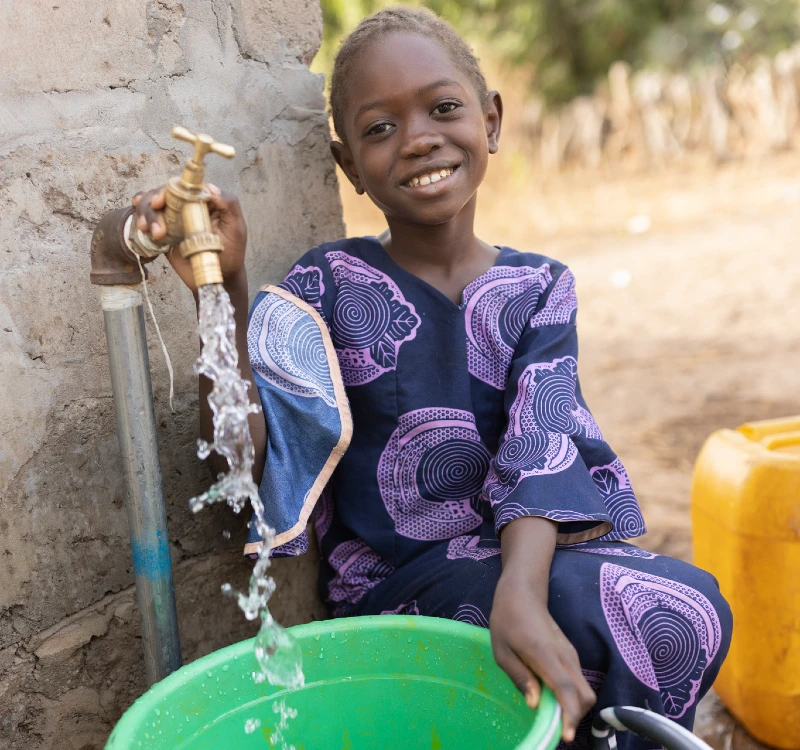
Every child, no matter where they live, has the right to safe water and sanitation.
Access to clean water remains a critical challenge for millions of people living in rural and semi-urban areas of The Gambia. According to UNICEF, only just over half of the water consumed in the country is considered safe from contamination, posing serious risks to the health and well-being of children and families. Thousands of open wells, dug by local communities and charitable organizations, provide water but often lack proper disinfection methods, exposing users to waterborne diseases.
The Public Utilities Regulation Authority (PURA) reports that the National Water and Electricity Company (NAWEC) is responsible for providing potable water services in urban areas. However, NAWEC’s operations primarily cover the Greater Banjul Area and the 10 Provincial Growth Centres. Water is sourced from underground boreholes, disinfected with chlorine before distribution, and monitored by the Department of Water Resources to ensure quality standards.
Despite these safeguards, the costs associated with applying for and connecting to NAWEC’s water supply system remain prohibitive for many households. This economic barrier leaves tens of thousands of families, including vulnerable children, dependent on unsafe water sources, undermining efforts to promote child health, reduce preventable diseases, and achieve sustainable development goals.
Our Impact
1.5 M +
6,800
22
850
Facts and figures from 2024 data.
Our Approach
At ChildFund, our WASH approach places the health, safety, and dignity of children, especially girls, at its core. We are committed to ensuring that children grow up and learn in environments where their basic needs are met and their rights are fully respected.
To keep children healthy at home and in school, ChildFund prioritizes access to clean water, sanitation facilities, and hygiene materials. We actively engage with community members to design and implement water provision strategies that focus on areas with the greatest need and limited access to safe water.
In our intervention areas, we support the drilling of boreholes powered by solar energy to provide reliable, sustainable, and clean water supplies. This renewable energy solution not only ensures consistent water access but also promotes environmental sustainability while empowering families and creating healthier, safer spaces for children to thrive.
We construct and rehabilitate water points, drill and equip boreholes and shallow wells, and lay pipeline extensions to reach underserved communities.. These systems reduce the time children, especially girls, spend fetching water, giving them more time to learn, play, and thrive.
In collaboration with our local partners, ChildFund, in 2024, constructed 5 water systems across 3 regions (Lower River, Western and Central River Region), providing access to clean water for over 10,000 people. These water systems are improving the lives of the communities by opening opportunities for horticulture activities, especially for women to earn an income and livelihood.
Learn More:
We build child-friendly latrines in schools and communities that are easy to use and maintain. Gender-segregated toilets ensure privacy and safety for girls and boys, supporting school attendance, especially for adolescent girls. We also install handwashing stations near latrines to promote regular hygiene practices and reduce disease transmission.
We promote hygiene education in schools and communities, educating children and families on how to prevent illness. We provide soap or suitable alternatives, install handwashing stations, and encourage routine hygiene practices. Our work also includes promoting integrated and gender-sensitive WASH in schools, recognizing the vital link between WASH services and education outcomes.
Learn More:
How Water is Transforming Education in Jiroff, Foni Kansala District
We design facilities that are accessible to children with disabilities, with inclusive features such as ramps, rails, and wide entries. We also work to make WASH spaces welcoming for all, helping reduce stigma and exclusion.
We recognize that safety concerns, especially for girls, can discourage the use of sanitation facilities. To address this, we install lighting along paths leading to and from latrines, creating safer environments, particularly at night. These measures help protect children from harm and contribute to a sense of security and well-being in their daily lives.
Sustainable change begins with community ownership. We work hand in hand with local communities, forming and supporting water and sanitation committees to oversee and maintain WASH infrastructure. These committees play a critical role in ensuring that services are well-managed, responsive to community needs, and continue functioning long after project completion.
To drive lasting impact, we strengthen WASH systems and promote environmental resilience. ChildFund collaborates with the Department of Water Resources under the Ministry of Fisheries and Water Resources to ensure technical oversight in the design, construction, quality control, and maintenance of water systems. We also work with partners to support WASH good governance, social accountability, and systems strengthening, ensuring that policies and practices align with the needs of children and communities.
Featured Project
Tendaba community now has a steady supply of safe and clean water
In Tendaba in Kiang district’s Lower River Region known for its thriving rural tourism and farming, access to clean water was once a daily struggle. The entire community depended on a single borehole that often ran dry during the day, forcing children to spend hours in line and women to ration limited water supplies. But that changed when local leaders partnered with ChildFund to address the urgent need. Today, thanks to a reliable water system complete with tanks, pipes, and taps installed across the village, families now have uninterrupted access to clean water, improving health, reducing hardship, and freeing up time for school, work, and home life.
With water now flowing to every corner of the village, including the nursery school, mosque, and local market, community life in Tendaba has transformed. Families have started backyard gardens, boosting food security and household income, while vital spaces like the Early Childhood Development Center—also supported by ChildFund—can now run without interruption.