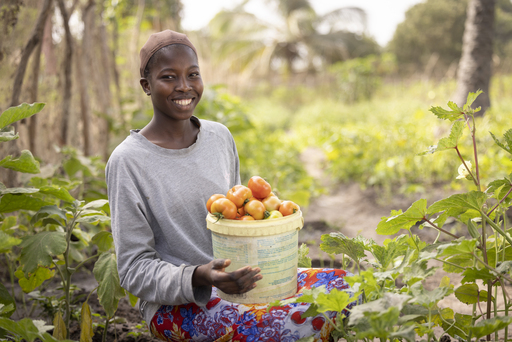
In the rural village of Lower Nuimi District in the North Bank Region, Mariama, a woman in her seventies, has...
The Gambia faces high levels of food insecurity and malnutrition, particularly among women, young people and children. 53 percent of the population lives in poverty, and 29 percent of the 2.4 million people are food insecure – according to the United Nations World Food Program.
Agriculture contributes 25 percent of the country’s GDP, employs 70 percent of the
population and is the source of livelihoods for 80 percent of rural inhabitants, yet it covers less than 50 percent of food requirements, leaving the population at the mercy of food importers. This leaves it vulnerable to price volatility, with high levels of food Inflation creating constant challenges for the poorest people.
Facts and figures from 2024 data.
ChildFund tackles the underlying issues of food insecurity through a multifaceted strategy, aiming to create lasting solutions rather than temporary relief. Our programs are designed to equip families with the tools, skills, and resources they need to build sustainable livelihoods. We focus on:
ChildFund supports smallholder farmers to strengthen food security and improve livelihoods through sustainable agriculture. Our approach focuses on enhancing food production, improving agricultural practices, and supporting families to grow and consume nutritious food.
In partnership with communities, we help establish and maintain community gardens by providing essential inputs such as fencing materials, quality seeds, water supply, and hands-on training in vegetable cultivation. These gardens improve household nutrition while also generating income from surplus produce. ChildFund also supports backyard gardening by encouraging families with access to small plots of land to grow vegetables at home, turning unused spaces into productive food sources.
To further enhance household food security, we provide vulnerable families with small ruminants such as goats and sheep. These animals contribute to family nutrition and act as a source of income, as families can sell offspring to support their children’s health, education, and well-being.
Learn More:
ChildFund provides emergency food assistance to families affected by crises, ensuring children and vulnerable households have access to essential nutrition during times of upheaval.
In The Gambia’s Western Region, ChildFund has been actively responding to the humanitarian crisis in the Foni districts, where communities have been repeatedly displaced by violent conflict between Senegalese forces and the Movement of Democratic Forces of Casamance (MFDC), a separatist group that is seeking independence from mainland Senegal.
Armed clashes, such as the February 2023 ambush by MFDC fighters that left three Senegalese soldiers dead and several captured, have triggered waves of displacement. That incident alone forced more than 20,000 people, including children and families, to flee their homes in search of safety. ChildFund continues to deliver timely support to such affected populations, with a focus on food aid, child protection, and psychosocial support.
Following research that revealed a 41% youth unemployment rate in The Gambia, ChildFund established a shoemaking and training facility in Brikama, West Coast Region, to expand employment opportunities for young people.
Implemented in partnership with Saama Kairo Federation, the initiative equips youth with practical skills and job opportunities while also supporting the livelihoods of local distributors and retailers who sell the factory’s finished products for both local and export markets.
The facility is a significant step toward addressing youth unemployment. It also serves as a model of good practice by discouraging the importation of basic sandals and other shoe brands, helping to reduce the strain on the national economy, which relies on imports for more than 95 percent of its goods.
To date, the program has enrolled more than two dozen youth, primarily young women, who are currently undergoing training at the center. It is also providing the local market with a variety of affordable shoes that were previously imported from neighboring countries and Asia.
ChildFund is in the final stages of constructing a Youth Multipurpose Center in Brikama, the second-largest town in The Gambia.
The center will feature a conference hall, migrant clinic, career counseling unit, resource center, and a playground for children and youth. Once completed, it will serve as a central hub for information and services related to adolescent and youth reproductive health, career development, and job creation.
Although still under construction, the center is already being used for select events. Once fully operational, it is expected to provide vital resources and support for youth engagement. It will also play a key role in addressing irregular migration and promoting economic opportunities for young people.
Horticulture plays a vital role in The Gambia’s socio-economic development, particularly for women who make up the majority of the sector’s workforce. According to the Department of Agriculture, women benefit from horticulture through increased income, employment, and improved household food security. To support this, ChildFund and its local partners work with communities to establish backyard gardens and enhance food production. In Bafuloto, Kombo Central District, Western Region, ChildFund installed a powerful water borehole in the community garden, significantly improving water access for irrigation.
Today, 180 women actively cultivate crops such as onions, lettuce, cabbage, bitter tomato, and eggplant. With a reliable water supply, the garden can now accommodate more women, resulting in increased yields and income.

In the rural village of Lower Nuimi District in the North Bank Region, Mariama, a woman in her seventies, has...

Young people in Sangajorr, Foni Kansala District, are turning to agriculture in a bid to tackle unemployment and reduce irregular...

For years, providing daily meals and meeting household expenses was a constant struggle for Ebrima. Today, that story has changed.