

How Water is Transforming Education in Jiroff, Foni Kansala District
March 19, 2022

Toulie, 5, drinks clean water at the school.
“If you don’t drink water, you won’t survive. It’s important for our health. When you’re thirsty, you cannot concentrate in class,” says Binta, a 13-year-old 6th grader at a ChildFund-supported school in Jiroff.
For many children in rural Gambia, access to clean water is a constant struggle. In fact, across the country, 50% of children in rural areas, especially girls, face barriers to education due to lack of access to clean water and sanitation. This challenge is especially pronounced in the Lower River Region, where one of the schools ChildFund supports is located.
Before ChildFund’s intervention, students at the school, which enrolls 350 children, were forced to leave class to fetch water from a nearby village—up to 20 minutes away. The school shared the same water source with the nearby community, and often, the supply ran out, further disrupting school activities. “We used to leave the school grounds and trek to the village to fetch water and bring it back to school. We suffered a lot because whenever the water ran out here, we had to leave class and go back to the village,” says Binta.
This disruption to learning, especially for girls, is a common issue across Sub-Saharan Africa, where 50% of girls drop out of primary school due to insufficient access to clean water and inadequate sanitation facilities (UNICEF Report 2016). But thanks to ChildFund’s timely intervention, the situation at Jiroff has drastically improved.

ChildFund, in collaboration with local partner Foni Ding Ding Federation, installed a solar-powered borehole with two distribution taps on the school grounds, providing the school and the surrounding community with reliable access to clean water. This intervention has eliminated the need for students to leave school during class hours to fetch water, ensuring that they can focus on their studies.
Beyond providing clean water, ChildFund’s Water, Sanitation, and Hygiene (WASH) programs in schools actively promote hygiene education. ChildFund installed handwashing stations and trains children and families on the importance of good hygiene to prevent illness. The organization supplies soap and encourages regular handwashing to maintain a healthy school environment. This proactive approach improves children’s health and increases school attendance and participation.
“Water is the most important aspect of ChildFund’s work here. Teachers were missing classes to find water and bring it back for their students. Now there is enough water here at school,” says Mr. Omar Baldeh, an English and Math teacher.
The improved access to water has had a remarkable impact on both attendance and academic performance. Prior to the intervention, the school struggled with low attendance, particularly among girls who were often tasked with fetching water. However, since the installation of the borehole, the school has seen a noticeable improvement in attendance. “Now, we have water here at school all the time, and we can study without distractions,” says Binta.
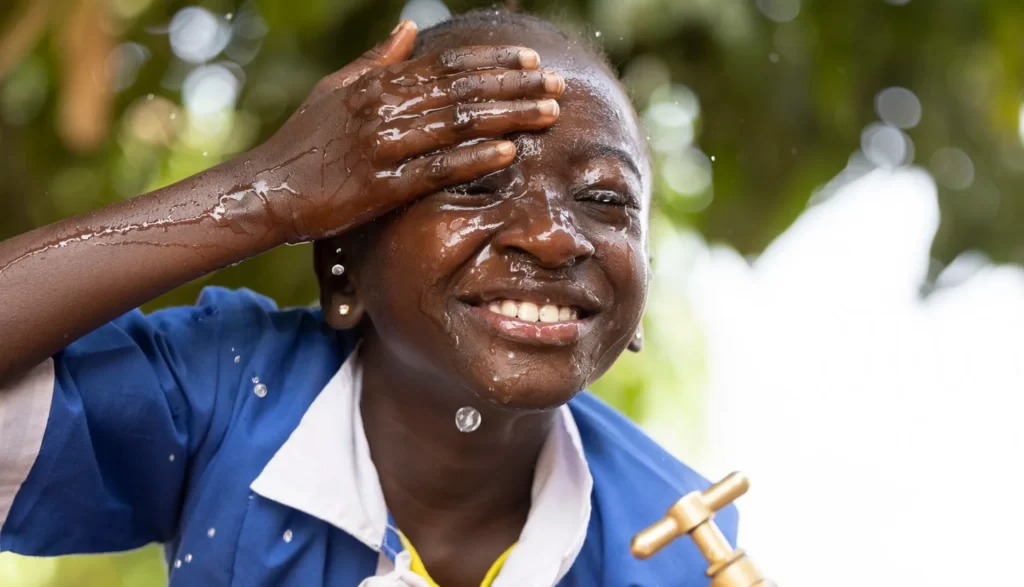
“I thank ChildFund for helping us and making this school a place where we can study well and get an education. Without the water project, the school would not have continued to exist for long because we were really suffering due to the lack of water,” Binta adds.
ChildFund’s intervention in this school is part of a broader commitment to ensuring that all children, especially girls, can access a quality education free from barriers like water scarcity.
“Access to clean water is a serious challenge for many children, particularly girls in rural communities, where long distances and unsafe water sources often force them to miss school. By addressing WASH issues and integrating gender-sensitive approaches to water access, we are transforming the learning environment and helping girls to stay in school and fully pursue their education,” says Nfamara Dabo, ChildFund’s Programs and Sponsorship Director.
With an average attendance rate of 99% since the water system was installed, the school is thriving. And with this improvement in education and health, the community is hopeful that these positive changes will continue to benefit future generations of students.
The positive effects of this project extend to the neighbouring community. Families have also benefited from the reliable water supply, with many starting small backyard gardens to grow vegetables. This increase in food production contributes to better nutrition for the families and helps alleviate some of the financial burdens on families.
ChildFund also provided students with play equipment like a tires course, jump ropes, and monkey bars. Students in need attending here received textbooks, pencils, erasers and school bags. Boys and girls living furthest from the school also received bikes with helmets and reflecting gear for a shorter and safer commute.


Related Resources

When silence hurts in secret: Fathers and Boys’ clubs challenge Gambia’s unspoken marital struggles
In The Gambia and across much of the sub-region, men are often raised to endure...

How a donkey cart transformed school access and boosted enrolment in rural CRN
In the rural village of Lower Nuimi District in the North Bank Region, Mariama, a...

ChildFund Launches School-Based Violence Prevention Program
The Program and Sponsorship Director emphasized that the act of violence Against Children in the...